
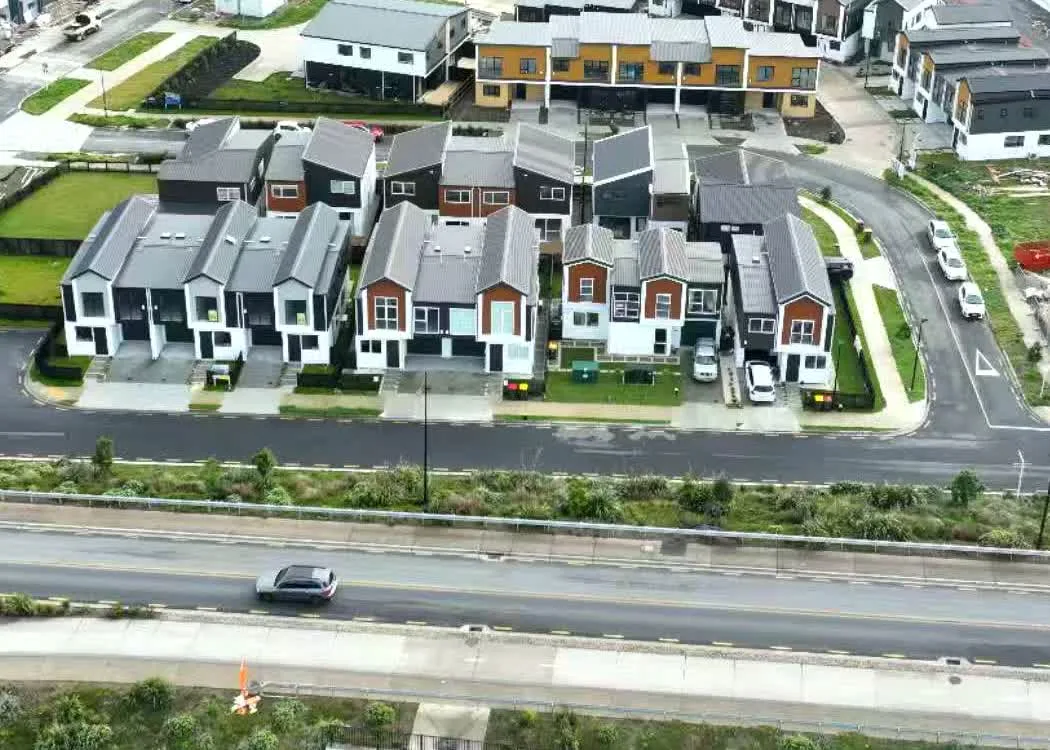
Riverside, Rosehill — site photography supplied by the developer.
Papakura’s gross rental yields currently run around 4.5–4.6% — among the strongest of any established Auckland suburb, and consistently at or above the region’s overall range of roughly 3.5–4.5%. At the same time, median sale prices in the suburb have eased over the past year. For an investor comparing where a dollar earns the most in rent relative to what it costs to buy, that combination is the actual reason more of them are looking south rather than at Auckland’s traditionally “safer” inner suburbs.
None of this is a promise of future capital growth. It’s a read of what the current rent, price and sales data show — and, just as importantly, what they don’t.
What is Papakura’s rental yield right now?
Gross rental yield is simple in principle: annual rent divided by purchase price. In practice, the exact figure moves depending on which sale price and which rent you use, so it’s worth showing the working rather than just quoting a number.
realestate.co.nz’s Auckland market data — drawing on REINZ sale figures and its own rental listings — puts Papakura’s median rental price for houses at $650 a week and its median sale price over the trailing 12 months at $735,939. Run that through: $650 × 52 weeks = $33,800 a year in rent, against a $735,939 purchase price, comes to a 4.59% gross yield. That lines up closely with the figures reported separately by NextMove Property Intelligence (4.53%) and cited elsewhere in the market (around 4.58%) — three independent reads landing in the same narrow band.
For context, PropertyMetrics NZ places Auckland’s overall gross yield range at roughly 3.5–4.5%, calling it the lowest of any major New Zealand city. Papakura sits at the top of that range, and by some calculations just above it — one of a handful of Auckland suburbs where the yield math genuinely stands out rather than blending into the regional average.
Why does Papakura yield more than the rest of Auckland?
Yield is a ratio, and ratios move when either side does. Papakura’s advantage comes almost entirely from the price side: rent for a three-bedroom house here isn’t dramatically lower than in much of Auckland, but the purchase price is.
PropertyMetrics NZ’s own illustration makes the point plainly: a three-bedroom house in Remuera at $2m yields barely 2%, while a comparable house in Papakura at $700k can yield 4.5–5%. It isn’t a one-off comparison, either — the wider South Auckland pattern holds. Manurewa and Ōtara post similarly strong gross yields in the 5.0–5.5% range, while central Auckland and North Shore suburbs average closer to 2.8–4.2%. As a broad rule, PropertyMetrics NZ describes South Auckland as the highest-yielding part of the region and the North Shore and central suburbs among the lowest.
Papakura isn’t the single highest-yielding suburb in Auckland — Manurewa and Ōtara post slightly stronger numbers — but it combines a strong yield with an established town centre, its own train station on the Southern Line, and a meaningfully larger and more liquid rental market than some of the smaller pockets that occasionally top the yield tables.
Have Papakura house prices actually fallen?
Yes, honestly — and it’s worth saying plainly rather than only citing the yield number. realestate.co.nz’s trailing 12-month data shows Papakura’s median sale price at $735,939, down 3.2% year-on-year, with the median asking price down further still, 6.2%. NextMove Property Intelligence’s independent snapshot from earlier in 2026 shows a similar pattern: a median sale price of $746,000 with prices down roughly 2.9% year-on-year. Properties are taking a little longer to sell too — a median 36 days to sale and 55 days on site, against 42 days reported by NextMove.
The detail that matters for a yield-focused reader is what happened to rent over the same period: only around 1.5% lower, according to realestate.co.nz — a much smaller move than the price decline. Because the numerator (rent) has held up better than the denominator (price) over the past year, the yield arithmetic has actually improved slightly for someone buying now compared with a year ago. That’s a genuinely different situation from a suburb where both rent and price are falling together, which is usually a sign of weakening demand rather than a buying window.
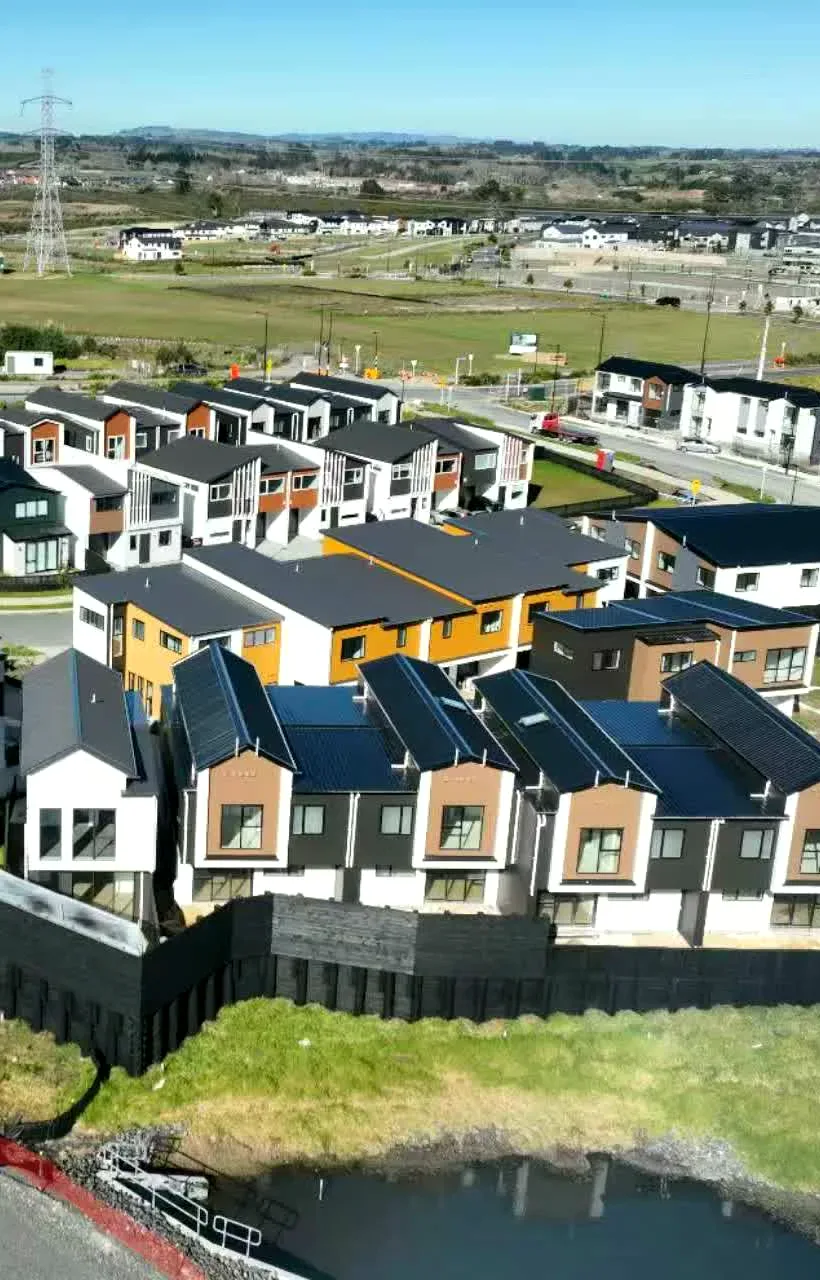
Riverside, Rosehill — site photography supplied by the developer.
What’s actually driving rental demand in Papakura?
Underneath the yield numbers is a straightforward affordability story. Central Auckland rents for houses commonly run $750–$900 a week, against Papakura’s roughly $650 median — a gap wide enough to keep a steady pool of tenants looking south. An estimated 45–51% of Papakura households rent rather than own, three-bedroom homes make up around 44% of tenancies, and properties are currently taking a median of around 29–30 days to find a tenant — a functioning, reasonably liquid rental market rather than a thin or speculative one.
Transport access plays a role too. Papakura sits on Auckland’s Southern Line, and the corridor immediately north has just had real investment land rather than merely being promised: Drury and Paerātā railway stations reopened to passengers on 2 August 2026, with Auckland’s City Rail Link following weeks later. Better transport access to the rest of Auckland tends to widen, not narrow, the pool of people willing to rent in an area — one part of why demand here has stayed resilient even as prices have softened.
What does this mean if you’re weighing up an investment property?
Taken together, the numbers describe a specific, checkable situation rather than a generic “South Auckland is booming” pitch: a gross yield around 4.5–4.6%, sitting at or above Auckland’s overall range; a median sale price that’s eased 3.2% over the past year while rent has eased only 1.5%; and a rental market — occupancy, tenancy mix, days-to-rent — that’s still functioning normally rather than showing signs of stress.
What it doesn’t tell you is what happens next. A strong current yield doesn’t guarantee future rental growth, and a softer sale price doesn’t guarantee a rebound — this is a description of where the numbers sit today, not a forecast. Gross yield also isn’t the same as your actual return: rates, insurance, body corporate or maintenance costs, finance costs, vacancy periods and your own tax position all sit between a gross yield figure and what actually lands in your account. None of this is personalised financial advice, and it isn’t intended to replace independent advice from a licensed financial adviser or your accountant about how it applies to your own position.
Further reading
Where Riverside fits into this market
Riverside is Park Homes’ masterplanned community at 115 Park Estate Road, Rosehill, Papakura — 104 homes, two to five bedrooms, from $650k, now selling, with completion staged through 2026 to 2028. It sits inside the same Papakura rental market described above: the same tenant pool, the same transport corridor, the same broad price and rent dynamics.
We haven’t run yield calculations on Riverside itself in this article, deliberately — a new-build home’s actual rental return depends on its specific size, configuration and finish, not the suburb median, and we’d rather a prospective investor work that out against real numbers than a general estimate. If you’re comparing Papakura against other parts of Auckland for an investment purchase, the Riverside development page has current facts, floor areas and pricing, and a link to a live listing to check against.